How to choose your first (or next) kayak
Everything that actually changes how a kayak paddles — in plain language, in the order it matters. No jargon for its own sake, no upselling.
1. Match the boat to your water
The single most useful question is where will you actually paddle? A calm local lake, a slow river, choppy open water, or the coast each point to a different hull. Be honest about the trips you'll really take, not the dream expedition. Most people are best served by a stable recreational kayak and grow from there.
Flatwater and beginners → recreational. Standing and casting → fishing. Distance and coast → touring. No storage or small car → inflatable. Two paddlers → tandem.
2. Sit-in vs sit-on-top
Sit-on-top kayaks are open-decked, self-draining, easy to climb back onto, and forgiving — ideal for warm weather, fishing, and nervous beginners. You will get wetter. Sit-in kayaks enclose your legs, keep you drier and warmer, and feel more connected and efficient, which is why touring boats use them. The trade-off is that re-entry after a capsize takes practice.
3. Length, width & stability
Two dimensions decide how a kayak feels. Longer boats track straighter and glide faster but turn slower and are harder to store and carry. Wider boats feel more stable and calm but are slower. A wide 10-footer is the friendliest first boat; a narrow 14-footer rewards skill with speed.
There are also two kinds of stability. Primary stability is how steady it feels sitting flat — what beginners notice. Secondary stability is how it holds when leaned on edge — what matters in waves. Wide rec boats have lots of primary; sea kayaks trade some of it for secondary stability that's reassuring in chop.
4. Weight capacity
Every kayak lists a maximum capacity — and you should never paddle near it. A boat loaded to its limit sits low, handles poorly, and takes on water. Aim to use no more than about 70% of the rated capacity once you add your body weight, a paddle, a PFD, water, and gear. For fishing or camping, that headroom matters even more.
5. Materials & weight
Most affordable kayaks are rotomolded polyethylene — tough, cheap, and heavy. Thermoform and composite hulls are lighter and stiffer (so they're faster and easier to carry), at a higher price. The number you'll feel every single trip is the boat's weight: a 70-lb kayak you can't lift onto the car alone is a boat that stays home. If you'll paddle solo, weigh the weight heavily.
6. Paddles & the PFD
Two pieces of gear are not optional. A paddle sized to your height and boat width is half your stroke — a lighter blade is the cheapest upgrade that makes paddling feel better. A well-fitted PFD (life vest) is the one piece of safety gear that saves lives, and the only one that works is the one you'll actually wear, so comfort and ventilation are worth paying for. Both live on our paddles & accessories page.
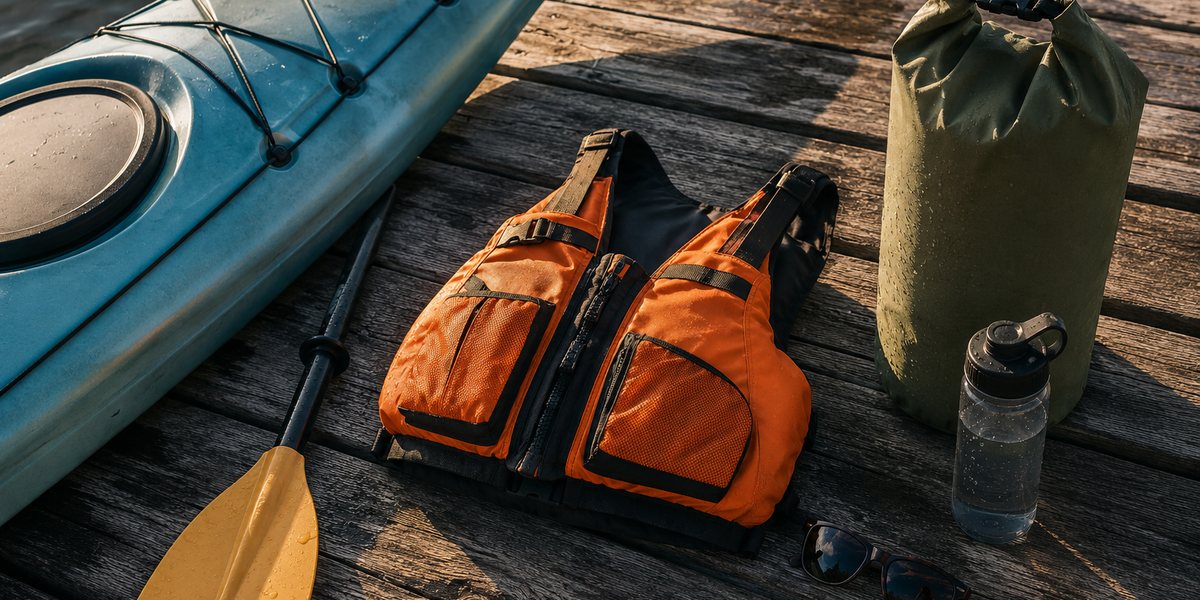
Always wear a PFD, tell someone your plan, check the weather and water temperature, and dress for the water temp — not the air. Cold water is the real danger, even on a warm day.
7. Getting it to the water
The most overlooked part of buying a kayak is moving it. A hardshell needs a roof rack or pads and straps, and a cart makes the walk from car to launch realistic when you're alone. If your storage or vehicle can't handle a 12-foot boat, a quality inflatable that packs into a bag is not a compromise — it's the right tool.
8. What to spend
You can get a genuinely good time on the water at every tier. Here's the honest lay of the land:
- Budget ($): Capable rec and inflatable boats that get you paddling. Heavier and more basic, but the water doesn't know what you paid.
- Mid-range ($$): The sweet spot for most people — better seats, better tracking, useful features, and durability that lasts years.
- Premium ($$$): Lighter materials, refined hulls, and pedal drives. Worth it when you paddle often or want top performance and the lowest weight.
Whatever the budget, don't skip the paddle and PFD to afford more boat — that's a trade you'll regret on the water.
Jump into a category
From finding fish to going below the surface
Part of a connected marine network — each site covers one job, end to end.